
Underwhelmed by Undertone
The first disappointment of the year

Dearest reader, April has come to an end. That means that I must write to you again about a new film that I watched. Unfortunately, this film was not like one from the last few months. I don’t want to say that “I didn’t like it,” because that feels quite hollow. But I know that I will probably not watch it again and I won’t necessarily recommend it to anyone. Not exactly a rave review, I know. But I didn’t hate it either. It’s in that weird middle ground where it almost feels like more of a waste of time and money than if it were something truly bad.
Okay, let’s get into it. The movie I watched is called Undertone. It’s an A24 horror film, which has become a subgenre of its own. A24 already deserves a lot of credit for the recent popularity in horror films, but I do think it’s become its own category of horror films. I’m not sure if it has to do with the aesthetics, the production quality or subject matter; they all just feel like they belong to the same universe of creepy hijinks.
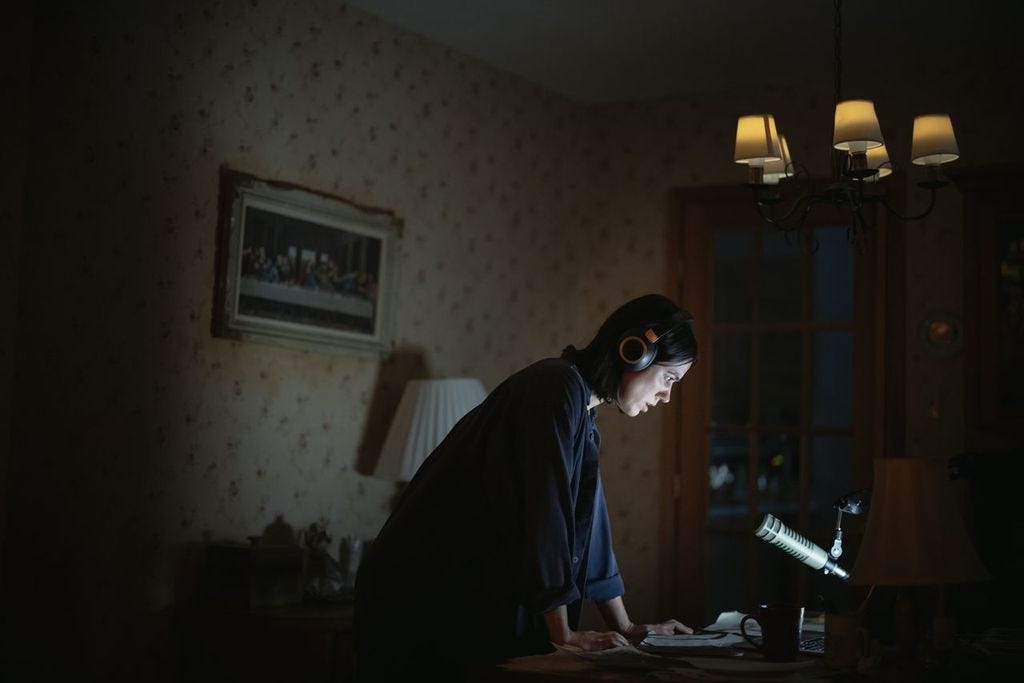
The film follows a young woman named Evy who’s living at her mothers house as her mother is slowly deteriorating. She’s also a podcaster who records a horror podcast with a vague friend named Justin who lives in London. In their podcast, they dissect supernatural occurrences. Justin is the more gullible character, meanwhile Evy is Ms. Logic and Reason. The duo receive a mysterious email with 10 audio files taunting them to listen. Intrigued, they dive in. As they make it through each file, Evy’s world seems to come apart in the same way that the people in the recording do.
My first and probably biggest complaint about this film is the styling and concept. I’m all for playing with form and I give props to any film that attempts it. Undertone is a mainly audio-based project. Audio is probably one of the most important and overlooked parts of filmmaking. It’s easily half of the film experience. However, with any experimental techniques, there’s the danger of taking the viewer out of the film. In the film, there seems to be an unspoken rule of only two people shown on screen: Evy and her dying mother. Everyone else is just an audio track. In some cases, for example in the case of Justin, the cohost, and her husband, it makes sense. She only ever calls Justin via audio (which I do wanna say is still a bit strange–speaking from experience, I’ve always video called for any podcasting projects), and she only talks to her husband on the phone. There is, however, a moment where there is a nurse paying a visit to her mom that stood out to me. Rather than allowing an additional character on screen, they seemed to ADR a voice in the film talking to Evy, with the camera only showing Evy in a one-sided conversation. Rather than appreciating the scene, I ended up just being completely confused as to why I couldn’t see the nurse. Unfortunately, I imagine this accidentally goes against the point of the scene
In addition to the confusing unspoken rules about who’s allowed to be on screen, there was nothing interesting visually in the film. Because the film is in one house, and with two characters and it’s about an audio-based medium, there is more than one scene where not a lot happens on screen. A few times I genuinely felt surprised that this film got green-lighted, because I can just hear my former film professors yelling about how film is a visual medium. There was a lot of montage used to fill in the gaps of visual information, which is something I quite enjoyed. Film school also taught me to try and avoid montage, but I personally enjoyed the way it was stylized in this film.
Another big red flag for me was the writing, which is rough for a film that is largely relying on audio. I was honestly shocked by the first scene where Evy talks to Justin. The delivery was rough, but I struggle to blame the actors. The writing was stiff and was literally the biggest no in all of dialogue writing. Justin was essentially throwing plot points at Evy hoping to make something seem interesting. But all it did was give me the impression that he’s an apathetic friend who likes to state obvious facts.
The final point that I will make builds off of that idea of apathetic characters. I found it very hard to have sympathy for Evy, and there are a few reasons why. Before I get into that though, I think the actress did an incredible job. She essentially carried the entire film because she was the only speaking or emoting character on screen. But the story did her no favors at all. There were a lot of loose ends that never got explored. I mentioned that she had a husband and that’s because it’s basically only mentioned in the film. It’s also suggested that their marriage is in trouble but never explained. Now that I mention it, I’m not completely sure that they’re married at all or if I just assumed that. It doesn’t matter because it’s never clarified or explored. There’s also a strange scene where Evy is suddenly swigging whisky. During a phone call Justin is able to tell and asks her if she’s been drinking again, insinuating some history with a drinking problem. Again, it’s pretty much not addressed or explained at any other point in the film other than that moment.
I’ve spent this entire article tearing this film apart, but to its credit, the film was interesting and creepy. It’s flawed and dare I say a bit juvenile, but it experimented and hopefully opened up some doors for more audio appreciation in film. I would probably say you could skip this one, but if for whatever reason you wanted to see what it’s about, I’m not stopping you. Happy watching and see you next month for something hopefully less disappointing!
Great essay. I read it quickly because it was interesting and well written. I probably won't see it as I don't usually watch horror movies, but the idea of audio being the plot drive is very intriguing.